

Quick Take
- Thalappil Pradeep is Institute Professor of chemistry at IIT Madras, Chennai.
- The Eni Award 2023 citation credits his group’s AMRIT filter with 70 million litres of arsenic-free and iron-free water a day, at 2.1 paise a litre.
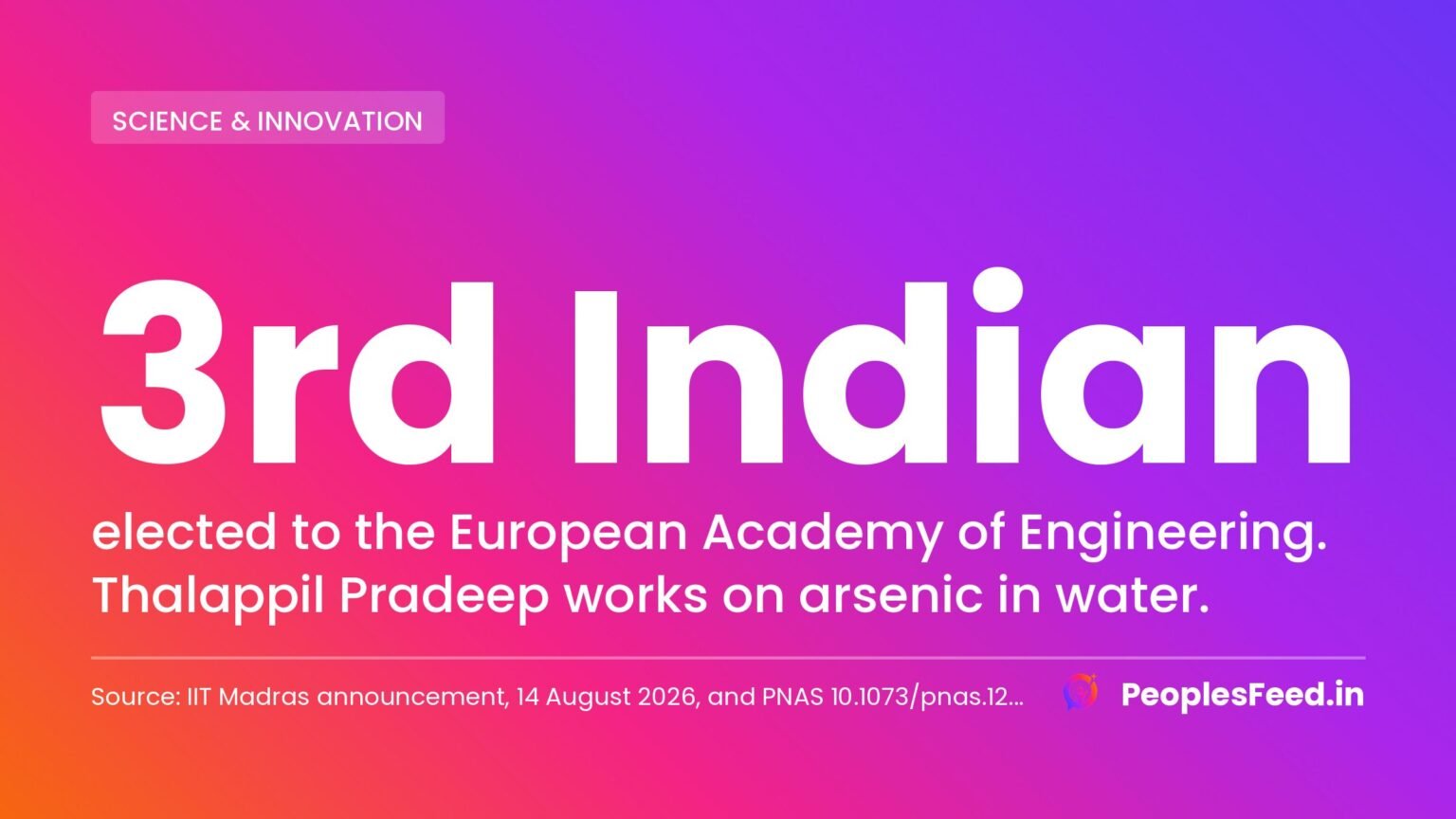
- IIT Madras said on August 14, 2026 that the European Academy of Engineering had elected him. The release called him the third Indian on its rolls.
A European academy elected Thalappil Pradeep of IIT Madras, Chennai, on August 14, 2026, for a water filter Indian government documents already name.
Peoples Feed checked the Thalappil Pradeep water record against sixteen documents on September 10, 2026. The biggest figure in all of them sits in an Italian award citation.
The Eni Award 2023 citation credits the filter with 70 million litres a day. That water is free of arsenic and iron, at a running cost of 2.1 paise a litre.
No Indian government document counts the people it reaches. Reported reach also differs by a factor of ten. The VinFuture Prize page says about 13 million people. The Eni citation says 1.3 million a day.
What the Thalappil Pradeep water technology actually does
AMRIT is a filter that strips arsenic from drinking water using nano-scale iron oxy-hydroxide. The Ministry of Jal Shakti gave that description to the Rajya Sabha on December 11, 2023.
The ministry spelled the name out as Arsenic and Metal Removal by Indian Technology. It credited IIT Madras in Chennai with developing the filter. The reply said the filter works at household scale and at community scale.
A written reply is a small thing. It is also the moment a laboratory idea becomes a line in an answer to Parliament.
The same reply covered arsenic more widely. It told the Rajya Sabha that all 378 arsenic-affected habitations without household tap connections had safe water through Community Water Purification Plants. The reply did not say how many of those plants use AMRIT.
How the filter was tested and what the paper claims
The underlying science was published on May 6, 2013 in the Proceedings of the National Academy of Sciences. The DOI is 10.1073/pnas.1220222110.
Eight authors are named on that paper, and Thalappil Pradeep is the last of them. The other seven are Mohan Udhaya Sankar, Sahaja Aigal, Shihabudheen M. Maliyekkal, Amrita Chaudhary, Anshup, Avula Anil Kumar and Kamalesh Chaudhari.
The paper ran in volume 110, issue 21, pages 8459 to 8464. Peoples Feed read it through the PubMed Central copy, PMC3666696.
The paper is careful about what it claims. It reports that 120 grams of the composite serves a family of five. The running cost given is US$2.5 a year.
One result in it is a laboratory result, not a field result. A single device processed 1,500 litres carrying 100,000 colony-forming units of bacteria per millilitre. It needed no reactivation over that run.
The record, verified against government and award documents
Thalappil Pradeep won the Shanti Swarup Bhatnagar Prize in chemical sciences in 2008. The CSIR list of that year records him as Dr Pradeep Thalappil of the Department of Chemistry, IIT Madras.
The Ministry of Home Affairs press note of January 25, 2020 carries him at serial number 133. The award is the Padma Shri in science and engineering, from Tamil Nadu.
Two foreign bodies have since cited the water work directly. The US National Academy of Engineering made him an International Member in 2024. Its citation reads “for contributions to cluster chemistry and the discovery and implementation of affordable drinking water solutions”.
Karlsruhe Institute of Technology gave him its first International Excellence Award on November 20, 2023. The KIT release named nanoscience and drinking water purification.
India’s own recognition came on December 23, 2025. President Droupadi Murmu conferred the Rashtriya Vigyan Puraskar 2025 on 24 scientists at Rashtrapati Bhavan. The Vigyan Shri in chemistry went to Pradeep.
| Date | What happened | Source document |
|---|---|---|
| 2008 | Shanti Swarup Bhatnagar Prize, chemical sciences | CSIR prize list, 2008 |
| May 6, 2013 | Point-of-use purification paper published | PNAS 110(21), DOI 10.1073/pnas.1220222110 |
| January 25, 2020 | Padma Shri, science and engineering, serial 133 | MHA press note, January 25, 2020 |
| 2022 | VinFuture Special Prize for Innovators from Developing Countries | VinFuture Prize laureate page |
| November 20, 2023 | KIT International Excellence Award | KIT press release 098/2023 |
| December 11, 2023 | AMRIT named in a Rajya Sabha reply on arsenic | PIB release PRID 1985137 |
| 2023 | Eni Award, Advanced Environmental Solutions | Eni Award 2023 citation |
| 2024 | International Member, US National Academy of Engineering | NAE member page |
| October 26, 2025 | Rashtriya Vigyan Puraskar, Vigyan Shri, announced | PIB release PRID 2182615 |
| December 23, 2025 | Award conferred by President Droupadi Murmu | PIB release PRID 2207860 |
| August 14, 2026 | Elected to the European Academy of Engineering | IIT Madras press release |
What is contested and what nobody has counted
The documents agree on the chemistry. They disagree on the arithmetic.
Four bodies have published a reach figure and no two match. The Eni Award 2023 citation says 1.3 million people a day. It adds more than 12 million served by a pesticide-removal product sold from 2007.
The VinFuture Prize page says community purifiers reach about 13 million people. It puts the pesticide filter at about 10 million.
A third figure is lower and comes from Pradeep himself. His May 2018 report to the Mashelkar Committee put arsenic-free supply at about 600,000 people a day. That report went to the then Ministry of Drinking Water Supply.
Those counts measure different things over different years. None has been audited in public. No Government of India figure for how many people AMRIT alone serves could be found.
The government’s own headline number covers every technology at once. The Ministry of Jal Shakti told the Rajya Sabha on December 9, 2024 that arsenic-affected habitations had fallen from 14,020 to 314.
The first figure is from August 2019 and the second from December 4, 2024.
That fall is credited to the Jal Jeevan Mission as a whole. No filter is named in the comparison.
Even the publication count is contested. The IIT Madras research portal IRINS lists 518 journal articles, 28,285 citations and an h-index of 79. His laboratory’s own page claims more than 615 papers and an h-index of 98.
Peoples Feed searched PIB, the Ministry of Home Affairs award lists, CSIR and the CAG audit portal on September 10, 2026. The same search covered the National Academy of Engineering, Eni, VinFuture, KIT, IIT Madras and general web results.
That search found no published criticism, pending inquiry or disputed claim against Thalappil Pradeep in connection with this work.
What happens next at IIT Madras
The European Academy of Engineering was founded in 1992 and sits in Gothenburg, Sweden. IIT Madras said on August 14, 2026 that its rolls include Nobel laureates, Fields medallists and Turing Award winners.
Only two Indians were members of the academy before this election. They are Professor C.N.R. Rao and Professor Biman Bagchi, both of the Indian Institute of Science, Bengaluru.
“I am deeply honoured to be elected to the European Academy of Engineering,” Pradeep said in that release. “This recognition strengthens my resolve to pursue new discoveries.”
In the same release, IIT Madras Director Professor V. Kamakoti called clean water technologies at scale “very important for a large country like Bharat”.
The vehicle for the next stage already exists. IIT Madras set up the International Centre for Clean Water in 2018, which Pradeep founded. Its campus page lists seven laboratories across 21,000 square feet.
What this means for you: Villagers in arsenic-affected habitations in West Bengal, Bihar, Assam and Jharkhand may already drink from a plant using this filter. Ask your gram panchayat which technology the plant uses, and when it was last tested.
Peoples Feed Insight
The weak link in this record is not the chemistry, it is the counting. India publishes a national figure for arsenic-affected habitations, 314 as on December 4, 2024. India publishes no figure for how many plants run on AMRIT. That gap is why reach numbers in award citations swing between 600,000 and 13 million. Anyone assessing this work should watch one thing: whether the Department of Drinking Water and Sanitation ever publishes a technology-wise break-up of Community Water Purification Plants. Until it does, the safest claim is the one in the 2013 PNAS paper.
By Harshvardhan Jain, Science and Technology Correspondent
About Thalappil Pradeep
Thalappil Pradeep is Institute Professor and Deepak Parekh Institute Chair Professor in the Department of Chemistry at IIT Madras, Chennai. His group developed the arsenic filter AMRIT. The Ministry of Jal Shakti named it in a Rajya Sabha reply on December 11, 2023. Pradeep won the Padma Shri in 2020 and the Rashtriya Vigyan Puraskar Vigyan Shri on December 23, 2025.
Know someone whose work should be on this page? Write to us at editorial@peoplesfeed.in.
Spotted an error? Peoples Feed corrects the record. Write to corrections@peoplesfeed.in and see our Public Corrections Policy.