

Quick Take
- GSLV-F17 placed the 2,367 kg EOS-05 in a sub-geosynchronous transfer orbit on September 4, 2026, at 02:55 IST.
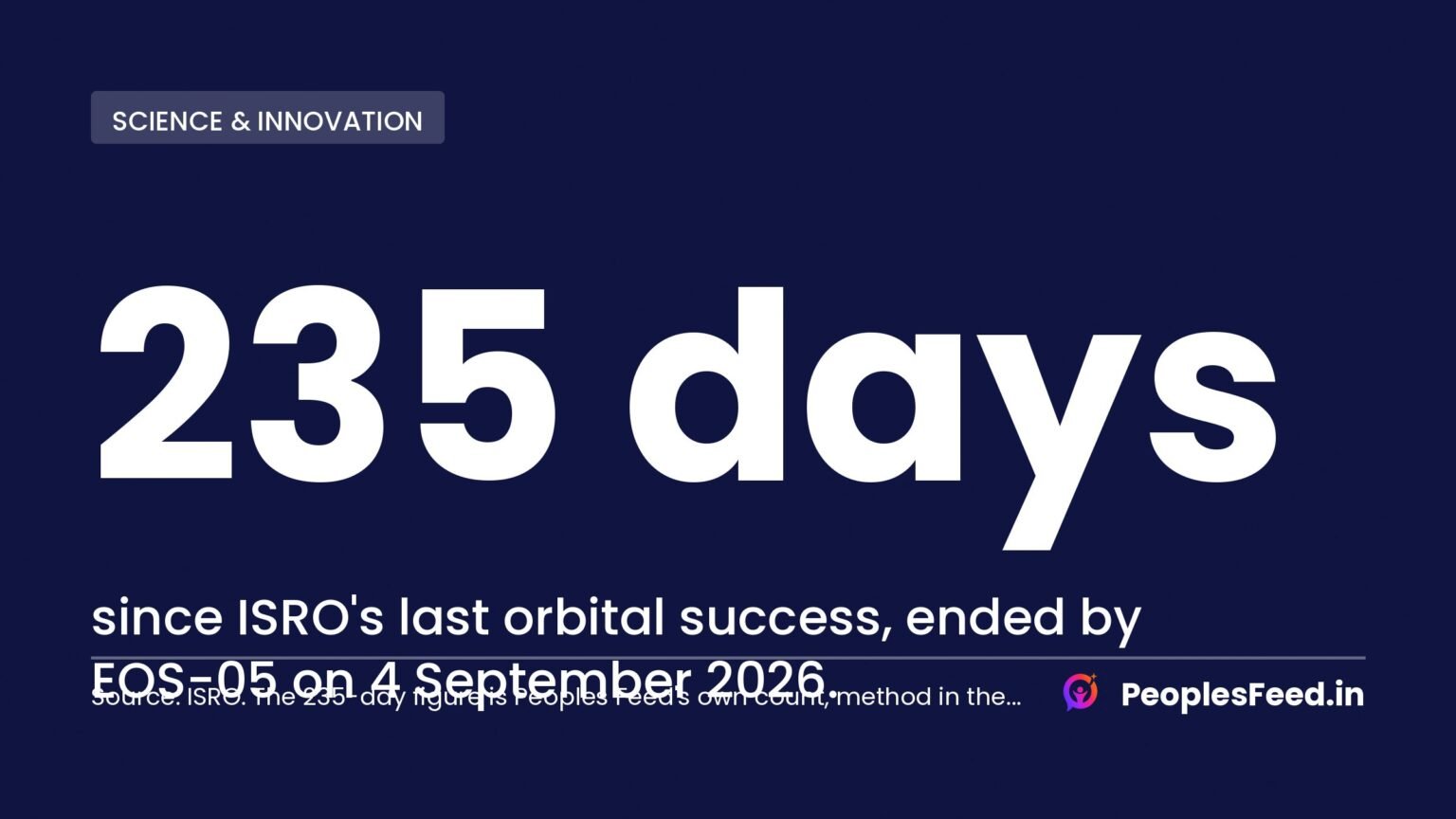
- It was ISRO’s first successful orbital launch in 235 days, counted from the PSLV-C62 failure of January 12, 2026.
- EOS-05 must now climb from 28,934 km to about 36,000 km on its own thrusters before it starts work.
GSLV-F17 lifted off from Sriharikota at 02:55 IST on September 4, 2026 and placed EOS-05, India’s first imaging satellite from geosynchronous orbit.
Peoples Feed timed the ISRO EOS-05 launch against the agency’s own mission pages. The gap since the last Indian orbital launch was 235 days.
That launch failed. PSLV-C62 lost EOS-N1 and 14 commercial payloads on January 12, 2026. GSLV-F17 was the second orbital launch India tried this year.
The satellite itself is the heaviest GSLV has carried. Its mass is 2,367 kg, against a lift-off mass of 420.5 tonnes for the 51.7 metre vehicle. ISRO has flown GSLV 19 times.
What the ISRO EOS-05 launch actually delivered
The mission put the spacecraft into a sub-geosynchronous transfer orbit, not its working orbit. The ISRO mission brochure gives the target as a perigee of 170 km, an apogee of 28,934 km and an inclination of 19.28 degrees.
ISRO said afterwards that the vehicle had placed the satellite in the intended orbit. The agency’s mission page calls EOS-05 “India’s first ever imaging satellite from Geosynchronous orbit”.
Dr V. Narayanan is Chairman of ISRO and Secretary, Department of Space. The Space Applications Centre records that he took charge on January 13, 2025.
The Federal quoted him at Sriharikota after the launch. “This is the 107th launch from Sriharikota and the 19th mission of GSLV,” Narayanan said. He added that the vehicle had injected the heaviest satellite GSLV has carried.
Two more names carried the mission. Business Standard reported Mission Director Thomas Kurien calling EOS-05 “the heaviest satellite ever launched by GSLV into a GTO or sub-GTO orbit”.
In the same report, Satellite Project Director Imteyaz Ahamad called it “a unique, one of its kind satellite with multi-band operating capabilities”.
Why 42 metres buys refresh rate, not sharpness
The spacecraft carries a multispectral mode with a best ground resolution of about 42 metres. WION reported that as the sharpest camera ISRO has placed in geostationary orbit.
That figure sounds coarse next to what India already flies. The Wire put the spread for low Earth orbit imaging satellites at 6 metres to 360 metres. The new camera sits inside a range India has had for years.
The gain is not sharpness. It is how often the picture refreshes.
A low orbit satellite passes over a district and leaves. WION reported that the new satellite can image a chosen region every five minutes, and the whole Indian landmass every 30 minutes.
For a cyclone, a cloudburst or a forest fire, that changes the arithmetic. A five-minute refresh at 42 metres can beat a sharper picture taken once in three days. That is the trade ISRO has bought.
Business Standard reported the intended uses as agriculture, disaster management and strategic national work. The Federal added water resources, urban planning, forestry, ocean resources and environmental monitoring.
The three failures behind this launch
India has tried to put an imaging satellite towards geostationary orbit before. GSLV-F10 carried EOS-03, also called GISAT-1, on August 12, 2021.
That launch failed. The Wire Science reported the then ISRO Chairman K. Sivan saying the mission could not be fully accomplished “mainly because there is a technical anomaly observed in the cryogenic stage”.
EOS-03 weighed 2,268 kg. EOS-05 is 99 kg heavier and reached orbit.
Two PSLV failures followed. The Wire reported that PSLV-C61 lost EOS-09 on May 18, 2025 after a third stage anomaly.
PSLV-C62 then failed on January 12, 2026, on the 64th PSLV flight. Narayanan told Akashvani that day that the vehicle showed “a slightly higher disturbance” in its roll rates.
That came near the end of the third stage. It was “followed by a deviation in the flight path”, the ISRO Chairman said.
| Mission | Launch date | What happened | Documented in |
|---|---|---|---|
| GSLV-F10 / EOS-03 | August 12, 2021 | Failed. Cryogenic stage anomaly. Satellite 2,268 kg | The Wire Science, August 12, 2021 |
| PSLV-C61 / EOS-09 | May 18, 2025 | Failed. Third stage anomaly | The Wire, September 2026 |
| PSLV-C62 / EOS-N1 | January 12, 2026 | Failed. Roll disturbance in third stage. 14 commercial payloads lost | Akashvani, January 12, 2026 |
| GSLV-F17 / EOS-05 | September 4, 2026 | Success. Sub-GTO injection. Satellite 2,367 kg | ISRO mission page and brochure |
What happens next for EOS-05
EOS-05 is not yet where it needs to be. The spacecraft must fire its own thrusters repeatedly to raise the 28,934 km apogee to about 36,000 km.
The Federal quoted Narayanan saying “the health of satellite is perfectly alright”. Injection came about 18 minutes after lift-off.
ISRO has not published a date for the first EOS-05 data product. Peoples Feed checked the agency’s mission page, its gallery and its home page on September 10, 2026 and found no such date.
The next vehicle is already in test. The ISRO home page lists a completed hot test of the CE20 cryogenic engine for the LVM3-M7 mission.
What this means for you: State disaster cells and agriculture departments are the first named users of EOS-05 data. Nothing reaches them yet, because the satellite must first raise itself from 28,934 km to about 36,000 km on its own thrusters.
Peoples Feed Insight
The number worth arguing about is 42 metres, not 2,367 kg. ISRO has traded picture sharpness for a five-minute refresh, and no Indian state disaster cell has ever worked with that combination. Whether EOS-05 matters will be settled by state officials, not by rocket engineers. The test to watch is narrow and datable. Will the National Remote Sensing Centre open routine EOS-05 products to state agencies within a year of the satellite reaching 36,000 km? If the data stays inside strategic users, this launch will have proved a rocket rather than changed a district.
By Suraj Prajapati, Contributing Editor
Know someone whose work should be on this page? Write to us at editorial@peoplesfeed.in.
Spotted an error? Peoples Feed corrects the record. Write to corrections@peoplesfeed.in and see our Public Corrections Policy.