

Quick Take
- The GST Council chaired by Nirmala Sitharaman replaced four tax slabs with two on September 3, 2025. New rates started on September 22, 2025.
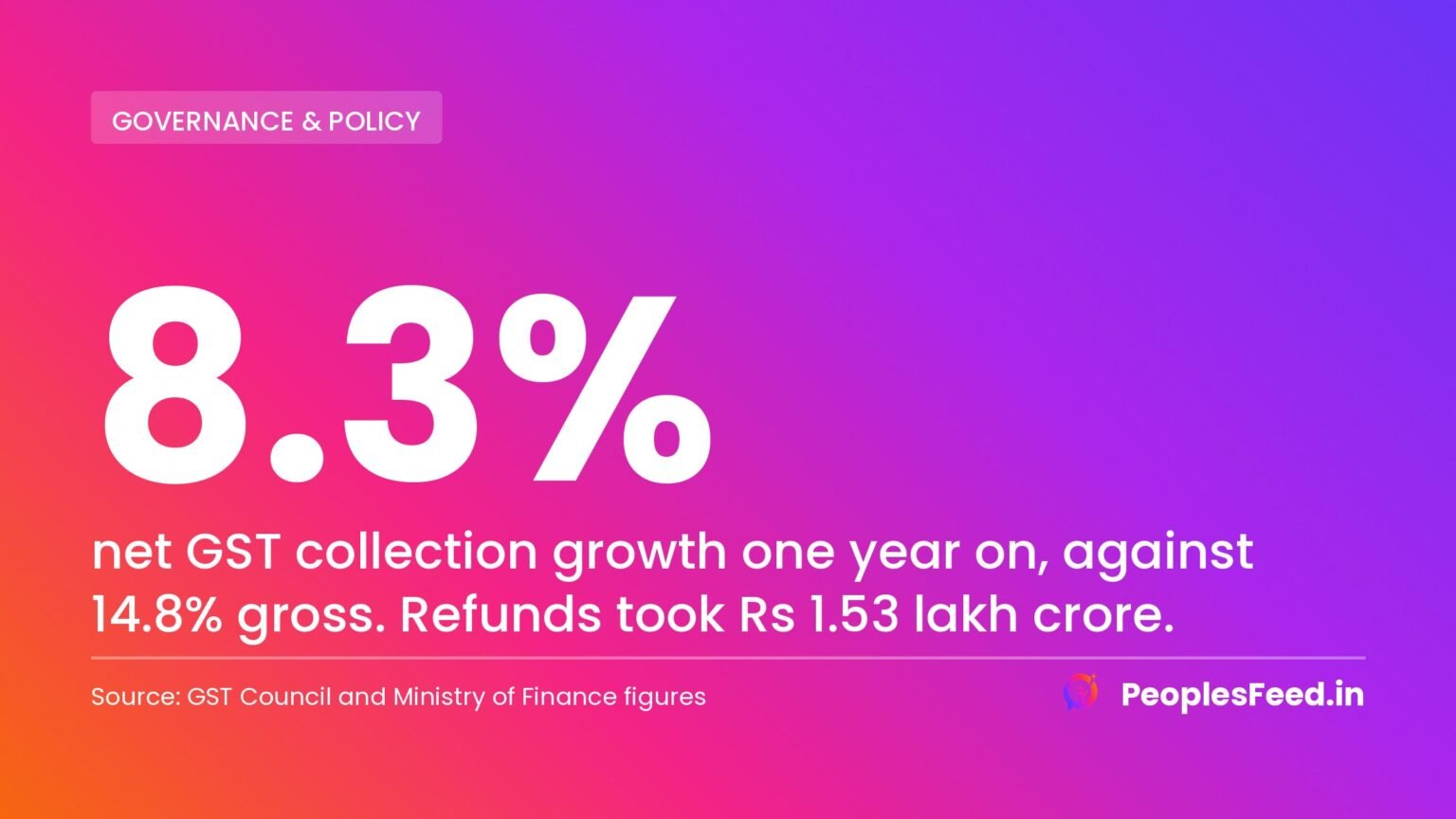
- Gross GST collection in August 2026 was Rs 1,99,853 crore, up 14.8%. Net collection rose 8.3%, to Rs 1.68 lakh crore.
- Nirmala Sitharaman told the Lok Sabha the cut would cost about Rs 47,700 crore in net revenue.
The GST Council that Nirmala Sitharaman chairs cut India’s tax slabs from four to two on September 3, 2025, in New Delhi.
Peoples Feed has read the Council’s own release and every collection figure since. The Sitharaman GST rate cut took effect on September 22, 2025.
Gross GST collection in August 2026 came to Rs 1,99,853 crore. That is 14.8% above August 2025.
Net collection tells a different story. It rose 8.3%, to Rs 1.68 lakh crore, a gap of 6.5 percentage points.
Refunds explain the gap. They reached Rs 31,795 crore in August 2026, up 67.9% on a year earlier.
What the Sitharaman GST rate cut changed
The Sitharaman GST rate cut replaced four slabs with two. Its standard rate is 18% and its merit rate 5%, with a 40% rate on a short list of goods.
The Council decided this in New Delhi on September 3, 2025, and its release calls the result a two-rate “Simple Tax”.
Insurance moved furthest. All individual life cover, including term, ULIP and endowment policies, went from 18% to nil. So did all individual health cover, including family floater and senior citizen plans.
Food followed. UHT milk and packaged paneer went from 5% to nil, Indian breads from 18% to nil, and 33 lifesaving medicines from 12% to nil.
Everyday goods dropped a slab. Hair oil, soap bars and toothpaste went from 18% to 5%, bicycles from 18% to 5%, and tractors and farm machinery from 12% to 5%.
Costlier goods moved too. Cement fell from 28% to 18%, and so did air conditioners, televisions and dishwashers.
What the collection figures show one year on
One year on, gross GST collection is growing faster than net collection, because refunds are growing faster than either.
The August 2026 figures set out the split. Domestic revenue was Rs 1.37 lakh crore, up 9.3%, and revenue on imports was Rs 62,604 crore, up 29%.
Domestic refunds alone came to Rs 18,490 crore, a rise of 73%.
The five-month picture is steadier. Gross collection from April to August 2026 was Rs 10.43 lakh crore, up 11%, against net collection of Rs 8.90 lakh crore, up 9%.
Peoples Feed subtracted the two. Rs 1.53 lakh crore, or 14.7% of everything collected this financial year, has gone back out in refunds and settlements.
Growth over nine years is larger still. The Press Information Bureau reported gross GST collection of Rs 22.27 lakh crore in 2025-26, against Rs 7.4 lakh crore in 2017-18.
Registration grew alongside it. Taxpayers on the GST rolls went from 66.5 lakh in 2017 to 1.65 crore in May 2026.
| Measure | Figure | Change on a year earlier |
|---|---|---|
| Gross GST collection, August 2026 | Rs 1,99,853 crore | up 14.8% |
| Net GST collection, August 2026 | Rs 1.68 lakh crore | up 8.3% |
| Total refunds, August 2026 | Rs 31,795 crore | up 67.9% |
| Domestic refunds, August 2026 | Rs 18,490 crore | up 73% |
| Domestic revenue, August 2026 | Rs 1.37 lakh crore | up 9.3% |
| Revenue on imports, August 2026 | Rs 62,604 crore | up 29% |
| Gross collection, April to August 2026 | Rs 10.43 lakh crore | up 11% |
| Net collection, April to August 2026 | Rs 8.90 lakh crore | up 9% |
What the states and the government say it costs
The government has costed the cut itself. In December 2025, Nirmala Sitharaman gave the Lok Sabha a net revenue loss of about Rs 47,700 crore.
In her reply, Nirmala Sitharaman broke the figure into two parts. Rate reductions take about Rs 93,300 crore out, and goods moved from 28% to 40% put about Rs 45,570 crore back.
Set that against one year of collection. Rs 47,700 crore is 2.1% of the Rs 22.27 lakh crore collected in 2025-26, by Peoples Feed’s arithmetic.
Eight states had asked for cover before the Council met. Himachal Pradesh, Jharkhand, Karnataka, Kerala, Punjab, Tamil Nadu, Telangana and West Bengal sought compensation on August 29, 2025.
Karnataka’s Finance Minister Krishna Byre Gowda put it bluntly that day. “The 20 per cent GST revenue loss will seriously destabilise the fiscal structure of state governments,” he said.
Those states put the total loss at Rs 1.5 lakh crore to Rs 2 lakh crore. They asked for five years of compensation, with 2024-25 as the base year.
Nirmala Sitharaman answered the criticism in the Lok Sabha on March 25, 2026. Her reply cited retail passenger vehicle sales up 26.1%, rural sales up 34%, two-wheeler sales up 25% and tractor purchases up 36.4%.
One independent finding cuts across her case. A National Institute of Public Finance and Policy study found price transmission uneven. Air conditioners and vehicles got cheaper, while frequently bought food items kept rising.
What happens next
The cut completes its first full year on September 21, 2026, which will give the first clean twelve-month comparison.
One part of it has still not started. The Council held cigarettes, chewing tobacco, unmanufactured tobacco and beedi at their old rates until compensation cess obligations are settled.
That date is not fixed. The Council’s release leaves the tobacco transition date for Nirmala Sitharaman to decide.
The next reading comes in early October 2026, when the September collection figure is published. It covers the first month of year two.
Appeals are the other thing to watch. The Council asked for the GST Appellate Tribunal to take appeals by the end of September 2025 and start hearings by December 2025.
Taxpayers face a second change alongside it. The Income-tax Act, 2025 came into force on April 1, 2026, replacing the 1961 law.
What this means for you: If you buy insurance, cement or a tractor, the rate you pay changed on September 22, 2025. Check your insurance renewal notice against the old rate, because the Council set individual life and health cover at nil.
Peoples Feed Insight
The number to watch is not the gross figure the government quotes. It is the gap between gross and net, which reached 6.5 percentage points in August 2026 as refunds rose 67.9%. Refunds that size are either a real unclogging of exporter and inverted-duty claims, or revenue moved from one year into another. One date settles it. September 2026 collection is due in early October, and that is the first month of year two. Watch whether buoyancy covers a cut Nirmala Sitharaman herself put at Rs 47,700 crore.
By Dr. Mayank Raj, Editor
Know someone whose work should be on this page? Write to us at editorial@peoplesfeed.in.
Spotted an error? Peoples Feed corrects the record. Write to corrections@peoplesfeed.in and see our Public Corrections Policy.