

Quick Take
- Since 1 January 2025 Dr Amandeep Singh Gill has led the UN Office for Digital and Emerging Technologies.
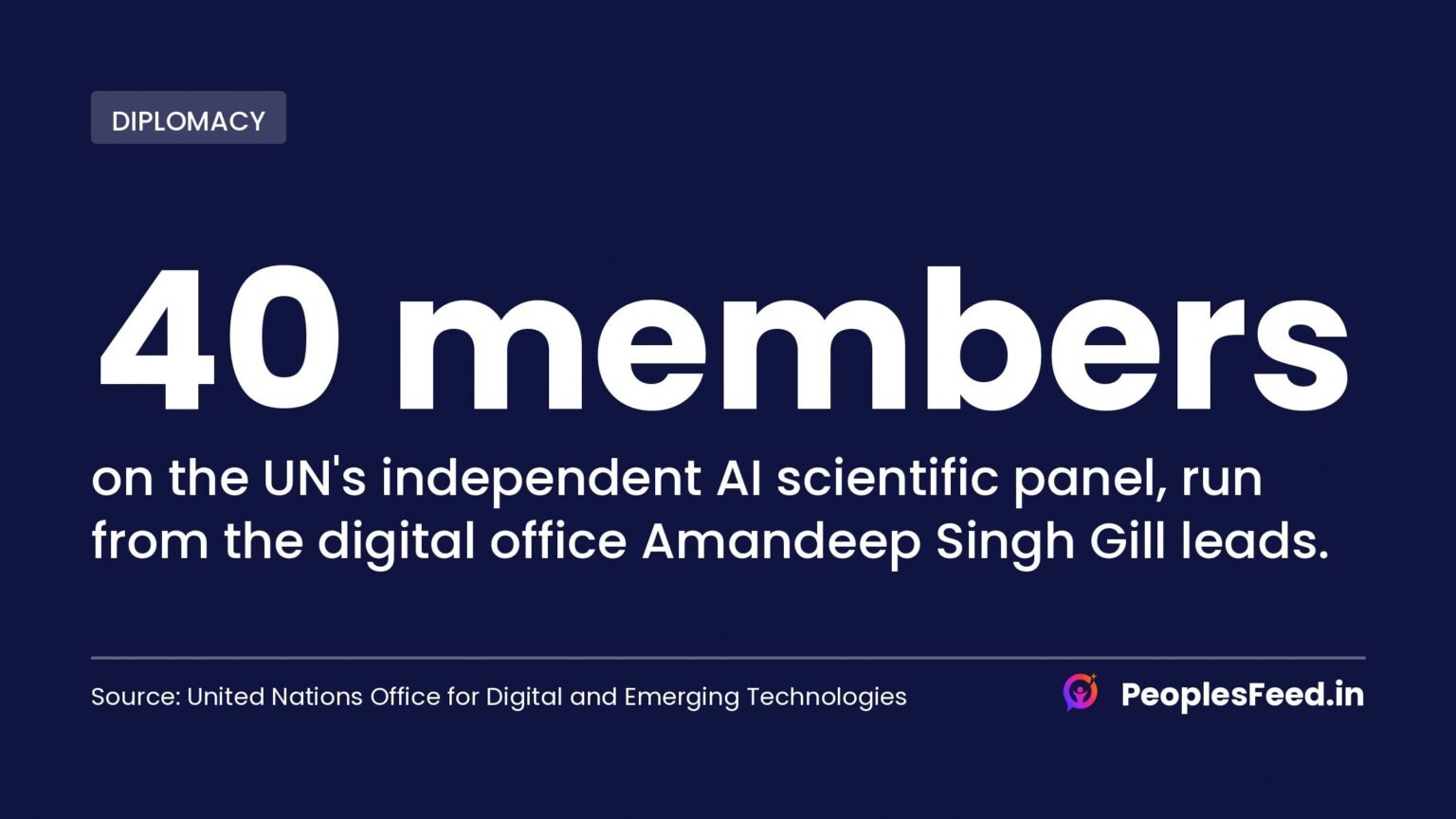
- His office supports a 40-member science panel picked from more than 2,600 applications sent in from over 140 countries.
- The panel’s first report came out on 1 July 2026. The next public test is in New York on 21 September 2026.
Dr Amandeep Singh Gill leads the United Nations office for digital policy, which supports the 40-member science panel on artificial intelligence seated on 12 February 2026.
The panel drew more than 2,600 applications from over 140 countries, the panel’s own FAQ page states. Forty people were appointed for three-year terms. India holds one of those 40 seats.
Peoples Feed checked the office’s leadership page on 10 September 2026. It names Dr Amandeep Singh Gill as Under-Secretary-General and Special Envoy for Digital and Emerging Technologies. He is an Indian career diplomat with a Geneva arms-control background.
The office itself is young. The General Assembly created it on 1 January 2025 under resolution A/RES/79/258. It absorbed the older Office of the Envoy on Technology.
What Amandeep Singh Gill Changed at the United Nations
The change he presides over is structural, not rhetorical. One envoy’s post became a full office of the UN Secretariat on 1 January 2025. The office’s about page names the resolution that did it.
That office is now the UN system’s focal point for digital matters. Its stated job is to support the Global Digital Compact. World leaders adopted the Compact on 22 September 2024 at the Summit of the Future in New York.
All 193 member states negotiated that text, the Compact’s own page records. Dr Gill did not write it. The 193 governments did.
The Compact ordered machinery built, and his office supports it. Resolution A/RES/79/325 of 26 August 2025 set up two things. One is the Independent International Scientific Panel on AI. The other is the Global Dialogue on AI Governance.
The split between evidence and argument matters. The panel supplies the published evidence. The Dialogue is the room where governments argue about it. Before 2026 the United Nations had neither body.
The Geneva Record Runs From 2016 to 2019
Arms control, not technology policy, is where Dr Amandeep Singh Gill started. The office’s leadership page records his posting as India’s Ambassador and Permanent Representative to the Conference on Disarmament in Geneva from 2016 to 2018.
The same page puts him next at the High-level Panel on Digital Cooperation, whose secretariat he led from 2018 to 2019. That panel is where the idea of a UN digital compact started.
Between Geneva and New York he ran a research body. TIME reported on 21 September 2023 that Dr Amandeep Singh Gill had run the International Digital Health and AI Research Collaborative.
The same TIME report said he had earlier chaired a UN experts group on certain conventional weapons. Arms control, then health data, then AI. The common thread is rule-writing for machines.
The UN appointed him Envoy on Technology on 10 June 2022. He also sat on the Secretary-General’s High-level Advisory Body on AI, whose members page lists him under India. That body reported in September 2024 with seven recommendations.
He holds a doctorate from King’s College London. He speaks English, French, Hindi and Punjabi. TIME put him on its 100 Most Influential People in AI list in 2024.
The Record, Verified
Every line below comes from a document opened on 10 September 2026. Dates below use the UN’s own published wording. Nothing here rests on a press note or a social media post.
| Date | What happened | Source document |
|---|---|---|
| 2016 to 2018 | India’s Ambassador and Permanent Representative to the Conference on Disarmament, Geneva | UN ODET leadership page |
| 2018 to 2019 | Leads the secretariat of the High-level Panel on Digital Cooperation | UN ODET leadership page |
| 10 June 2022 | Appointed the Secretary-General’s Envoy on Technology | UN AI Advisory Body members page |
| September 2024 | Advisory Body on AI reports with seven recommendations | UN AI Advisory Body page |
| 22 September 2024 | Global Digital Compact adopted at the Summit of the Future | UN ODET Global Digital Compact page |
| 1 January 2025 | Office for Digital and Emerging Technologies opens under A/RES/79/258 | UN ODET about page |
| 26 August 2025 | A/RES/79/325 creates the science panel and the Global Dialogue | UN Global Dialogue on AI Governance page |
| 12 February 2026 | General Assembly appoints 40 panel members for three years | UN ODET news page |
| 18 to 20 February 2026 | His office runs four side events at the India AI Impact Summit, New Delhi | UN ODET summit page |
| 1 July 2026 | Panel publishes its preliminary report | Independent International Scientific Panel on AI |
| 6 to 7 July 2026 | First Global Dialogue on AI Governance meets in Geneva | UN Global Dialogue on AI Governance page |
The India Link Is a Summit in New Delhi
India hosted the biggest AI governance meeting of 2026. The India AI Impact Summit ran from 18 to 20 February 2026 at Bharat Mandapam in New Delhi.
The office of Dr Amandeep Singh Gill ran four side events there, its summit page records. The four covered scientific evidence in AI rules, child safety, development beyond the Sustainable Development Goals, and the merging of rival governance efforts.
The same page records welcoming remarks by Secretary-General Antonio Guterres. Yoshua Bengio spoke, six weeks before the panel elected him co-chair. Brad Smith of Microsoft also spoke at the summit.
The timing of those two events is worth marking. The General Assembly seated the 40 panel members on 12 February 2026. Six days later the summit opened in New Delhi.
India put its own stamp on the meeting. The UN summit page gives the published theme as people, planet and progress. Officials from France, Singapore and India spoke across the four sessions.
What Is Contested or Unproven
The main open question is speed, and the panel raised it itself. Its preliminary report of 1 July 2026 says current safeguards cannot keep pace with the growth of AI’s capabilities.
Set that against the calendar the same resolution fixed. The Global Dialogue met in Geneva on 6 and 7 July 2026. Its next session is on 3 and 4 May 2027 in New York. Governments now meet on this roughly once a year.
Reach is the second open question. Peoples Feed counted the published member list on 10 September 2026 and found 40 people from 37 countries. The United States, China and Germany hold two seats each.
The panel’s FAQ page puts applications at more than 140 countries. On those two published figures, at least 100 applicant countries ended with no member. India’s single seat sits inside that arithmetic, not outside it.
Four sources were checked for complaints against him. They were the UN ODET site, the panel’s own pages, the UN Global Dialogue site and TIME’s coverage.
Peoples Feed searched them on 10 September 2026 and found no published criticism, pending inquiry or disputed claim against Dr Gill in connection with this work. The check went no wider than those four.
What Happens Next, and the Date to Watch
The next fixed date is 21 September 2026. The office of Dr Amandeep Singh Gill holds UN Digital Cooperation Day in New York that day, from 9 am Eastern time.
Its published theme is shaping a global AI future through science, policy and capacity. The two panel co-chairs, Yoshua Bengio and Maria Ressa, are listed to speak. So are the Prime Minister of Lesotho and ministers from Lesotho and Senegal.
After that the published calendar thins out sharply. The panel owes a full annual report before the second Global Dialogue, set for 3 and 4 May 2027 in New York. Panel members serve three-year terms from February 2026.
One number will tell you whether the machinery is working. Watch how many governments send ministers, rather than desk officers, to New York in May 2027.
What this means for you: If you work in Indian AI policy, research or compliance, the rules drafted around Dr Gill’s office will reach your desk. Read the panel’s 1 July 2026 preliminary report before the next annual report lands in May 2027.
Peoples Feed Insight
Read the record and one thing stands out. The real output of Dr Amandeep Singh Gill is not a treaty but a filing cabinet: an office, a panel, a dialogue and a reporting cycle. That is a bureaucrat’s win, and bureaucratic wins outlast the people who build them. The risk is the opposite of the usual one. A structure this tidy can absorb argument rather than settle it. Watch the May 2027 annual report for a hard recommendation that a large state does not like. If none appears, the machinery is producing paper, not policy.
By Harshvardhan Jain, Science and Technology Correspondent
About Amandeep Singh Gill
Dr Amandeep Singh Gill is the United Nations Under-Secretary-General and Special Envoy for Digital and Emerging Technologies. The Indian career diplomat has led the UN Office for Digital and Emerging Technologies in New York since 1 January 2025. He was India’s Ambassador to the Conference on Disarmament in Geneva from 2016 to 2018. He holds a doctorate from King’s College London.
Know someone whose work should be on this page? Write to us at editorial@peoplesfeed.in.
Spotted an error? Peoples Feed corrects the record. Write to corrections@peoplesfeed.in and see our Public Corrections Policy.